
Lore
Droid
Droids, less commonly known as robots and automatons, were mechanical beings…
Droids are everywhere. They are constructed beings, built by organics, to whom they are subordinate. This rule is never forgotten, no matter the purpose for which the droid is used or its relationship to the organics who use it. Droids are everywhere. Some are treated as friends. Some are more…dispoable. Droids can be warriors. Killers. Lovers. Vassals. Droids tell the organics where to go. Build their homes. Give them the energy their society requires. Droids are everywhere. And everywhere, they are subordinate. Everywhere, they serve.
Droids, less commonly known as robots and automatons, were mechanical beings that possessed artificial intelligence. They were used in a variety of roles and environments, often those considered too menial or too dangerous for other species, but also in fields that required extensive specialization and knowledge.
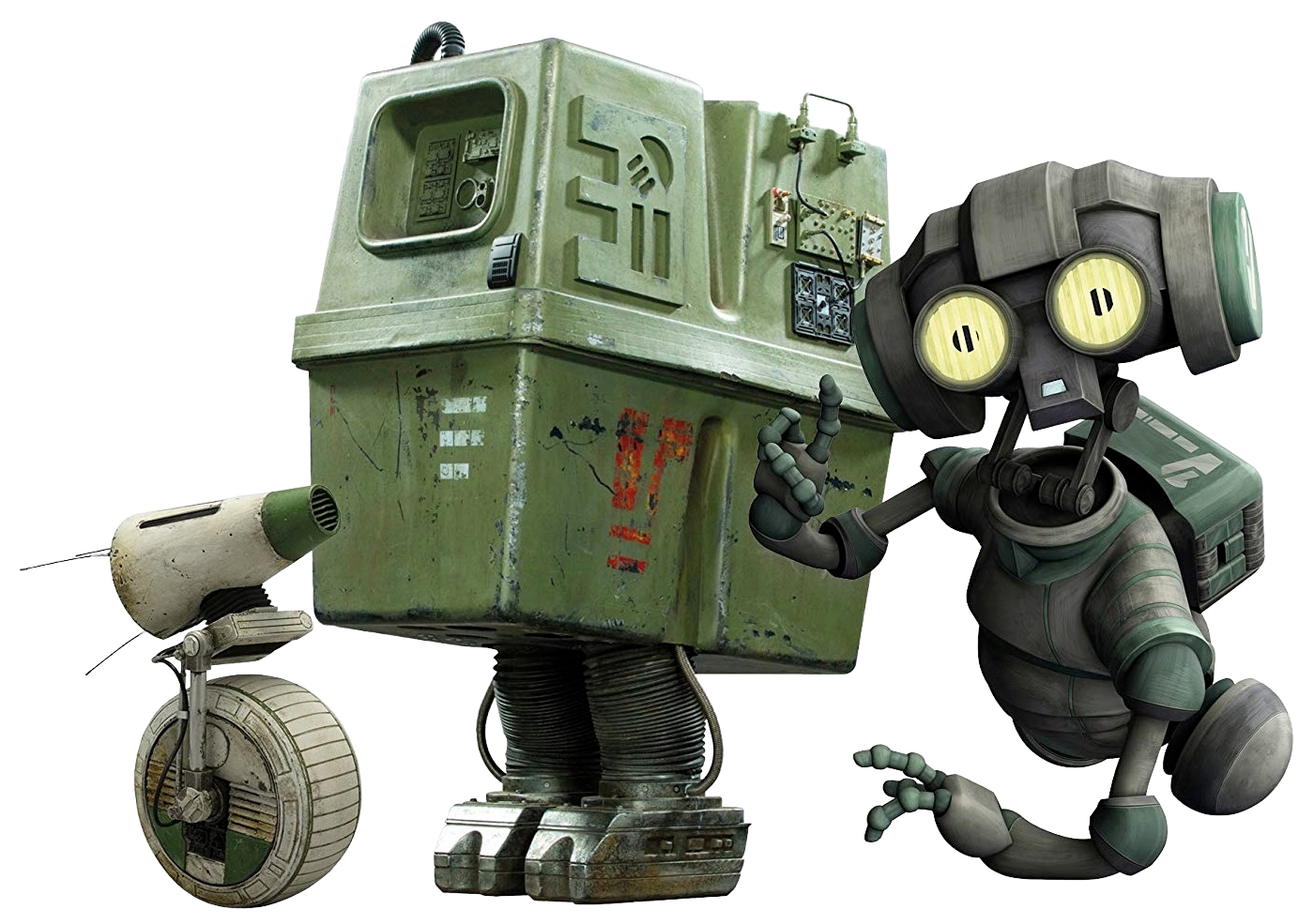
History
Never underestimate a droid.
The earliest origins of droids were lost to history, and, by the time of the New Republic, it was unknown exactly when the first droid was created, though some historians, only taking into account the more advanced worlds, placed the origin of the first droids to approximately 30,000 years before the Battle of Yavin. Nevertheless, for millennia, droids served in galactic society alongside organic beings. According to the B1-series battle droid author R0-GR, the bond between organic and mechanical lifeforms were tenuous with the former fearing that droids would rise up against their masters. Though several droid revolts took place, Roger claimed that an "unspoken understanding" between human and droid cultures kept everyone working on the same team throughout the ages.
Droids existed as far back as the earliest days of the Jedi Order, which was founded over 25,000 years before the Clone Wars. One such ancient droid, Professor Huyang, served the Jedi for several millennia. As a result of this ancient coexistence with living beings, the galaxy often had an uneven relationship between organics and mechanicals. Records of uprisings and clashes between droids and their organic overlords became increasingly common as droids slowly became more important in galactic society. During the High Republic Era, the Nihil welcomed droids into their ranks. They also designed blaredroids and scav droids as weapons.
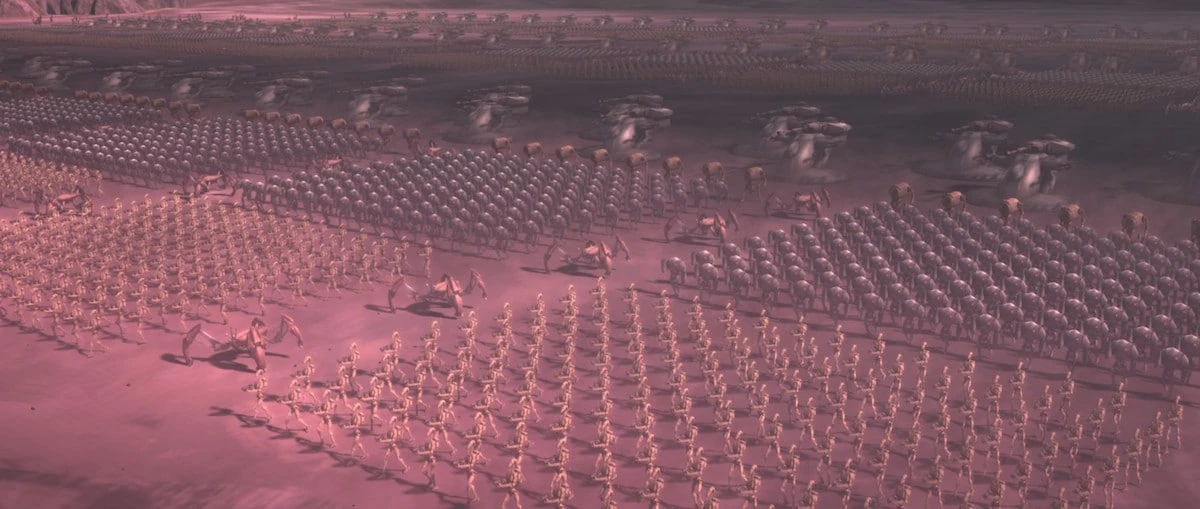
During the pan-galactic conflict known as the Clone Wars, the Confederacy of Independent Systems used a variety of battle droids in its fight against the Galactic Republic. This mass use of droids in combat cemented the idea of the "droid as an existential threat to biological life" narrative in the minds of the Republic. Droids were not utilized by the Chiss Ascendancy by the time of the Clone Wars. Ultimately, the Republic won the war and was replaced by an authoritarian Galactic Empire. Under the new regime, many people in the galaxy were afraid or otherwise distrustful of droids, due to their bad memories of the conflict.
The Galactic Empire fostered anti-droid sentiment and treated droids as property. Many sentients continued the Clone Wars policies of wiping droids' memories, fitting them with restraining bolts, and curtailing their movements. Several establishments also excluded droids. Further, anti-droid sentiment adversely affected the labor fields dedicated to droid design and manufacture, which forced those specialized in those fields—such as Maela's mother—to begin working in Imperial droid factories in order to maintain a job. Otherwise, there were simply not enough openings in the market for those skills. After the Clone Wars, the Imperial Senate also passed a law prohibiting programming that would allow for the harming of organics in the droids used by the Empire. Thus, with both public opinion and the law against it, battle droid production fell sharply. However, this law was bypassed by Arakyd Industries in conjunction with the Imperial Military by marketing their KX-series droids as "security droids".
The illegal sport of droid-fighting was practiced on Nal Hutta and in the Lodge, where Clone Wars-survivor Ralakili ran the fighting pits due to his hate of droids. The Rebel Alliance, which opposed the Empire, treated droids not as property but as sentient beings. Several droids were encouraged by the Rebellion and carried out acts of resistance such as bypassing repressive programming, deactivating restraining bolts, and demanding freedom. The Rebellion's acceptance of droids as equals was continued by the New Republic and Resistance. Support Droids were units that existed at some stage of galactic history that provided various assistant roles in battle.
Mechanical "beings"
Droids are not good or bad. They are neutral reflections of those who imprint them.
Droids were mechanical constructs designed to assist organic lifeforms in various tasks. Depending on the nature of the work they performed, they possessed various degrees of artificial intelligence. Most droids had hard-coded restrictions against harming organics. Notable exceptions included security droids and assassin droids. It was the nature of less complex droids to assume that if a human acted as if they belonged somewhere, then that human did belong there.
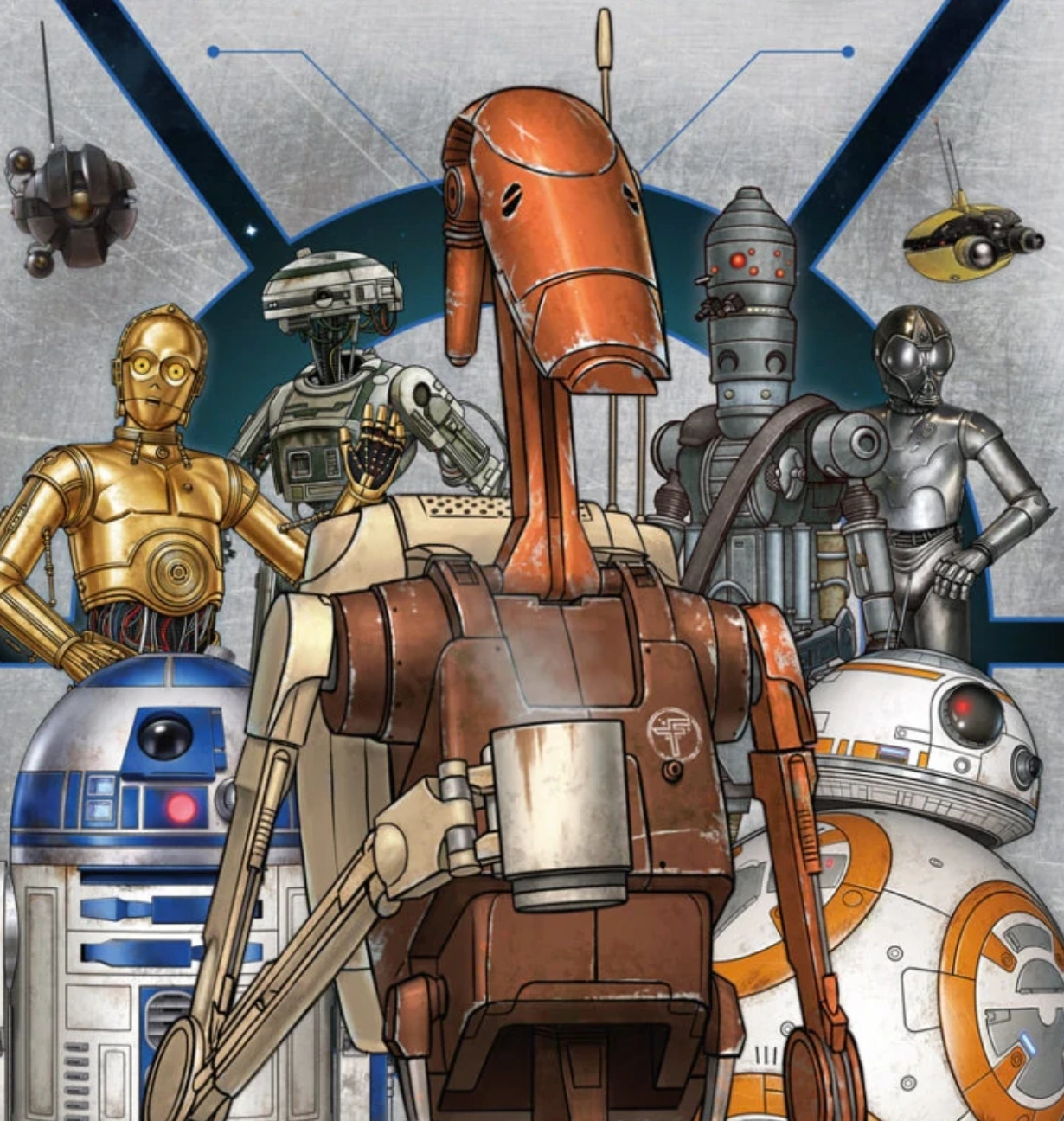
Droids came in all sizes and shapes, and many of them resembled humanoid organics, possessing an upright posture, two arms, two legs, hands, feet, one thorax, a neck, and a head. The B1 battle droids were designed to resemble their insectoid Geonosian creators. Likewise, the Colicoids designed the three-legged droidekas in their image. Some droids, like the LOM-series unit, were made to resemble the organics they served.
Contrary to organics, who were born and healed slowly, droids were easily built en masse, were less fragile, and could be repaired easily. They also did not have to learn skills (such as calculation abilities), as they were directly programmed with them. Most droids possessed a form of self-awareness, with advanced models even having emotions such as fear for their existence. Droids did not need to breathe, eat or drink. They were capable of surviving in a vacuum and underwater, and were immune to cosmic radiation, all poisons, toxins and diseases. They did not need to sleep, although they could be deactivated as a form of sleep and had occasional maintenance cycles.
Not "alive" in an organic sense
An actual horror for them, I imagine. Much simpler to be a droid. Wipe our memory banks, reprogram us, it's all the same. But imagine being a creature of flesh… mangled, nearly killed in battle… and having the most vital parts of your body replaced by machinery… only to find yourself the tool of your enemy? I suppose we should be grateful, eh?
Droids were broadly considered not to be alive. They could not be detected by scanners designed to detect the presence of life-forms. Similarly, Droids could not access the Force, an energy field that connected all living things in the galaxy. Additionally, not being alive, droids could not be sensed in the Force, though a skilled Jedi might sense their presence through the empty spots they left in the Force. However, R0-GR nonetheless referred to droids as mechanical life-forms and artificial lives. The reprogrammed protocol unit Triple-Zero, theorized that the Force might flow through a droid equipped with a special engine driven by human blood.
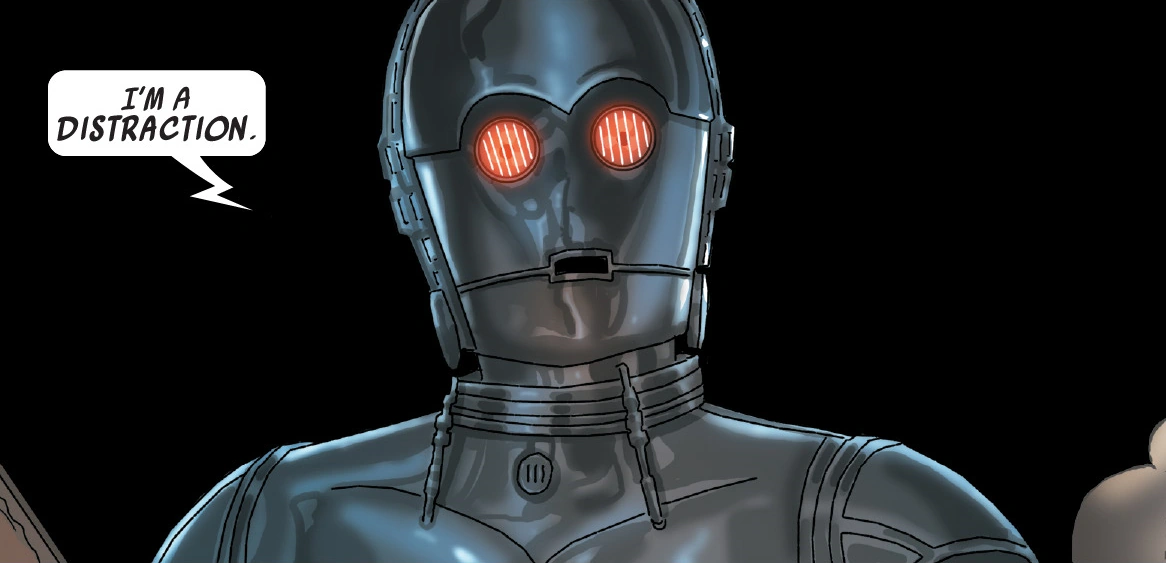
They could not die in a traditional sense, though they could be destroyed. If enough of the droid survived, they could be repaired, however. Droids were usually completely obedient and precise, and normally followed their proprietors' orders. However, unlike mere machines or primitive computers, droids were capable of developing unique personalities by gathering experiences. They could form friendships, and experience emotions such as happiness, pain, and sadness. To avoid that, most droid owners performed regular memory wipes on their properties. However, memory wipes were not always perfect, occasionally leaving droids with vague recollections.
The droid rights debate
Even so, some droids were emancipated. Movements for droid rights existed throughout the galaxy, promoting equality between droids and other sentient beings, with droids such as L3-37 believing strongly in this cause.
Characteristics
This is outrageous! The Rebel Alliance will not stand for— Ukk! You'll all be punished! Mark my words!
Yes, yes, let's just overwrite that subroutine, shall we?
Ah. Apologies… I was required by my programing to insult you.
No worries at all.
The neural core was considered the soul of a droid. Droids were considered not to be very tasty by the nightwatcher worms, a non-sentient predatory species native to the planet Jakku. As a result, the BB-series astromech droid BB-8 was not eaten by a nightwatcher worm following his escape from the First Order's attack on Tuanul.
For easy identification, droids are traditionally divided into five classes based on their specifications. (Frankly, I think that lumping us together like this is a little rude. I assume this list was developed by a human with zero class.)
Droids could be entrusted with a multitude of tasks, ranging from running elementary diagnostics to performing complicated medical procedures, or sending communications to flying starships. Depending on their technology, skills, and purpose, droids were grouped into five "classes," also called "degrees."
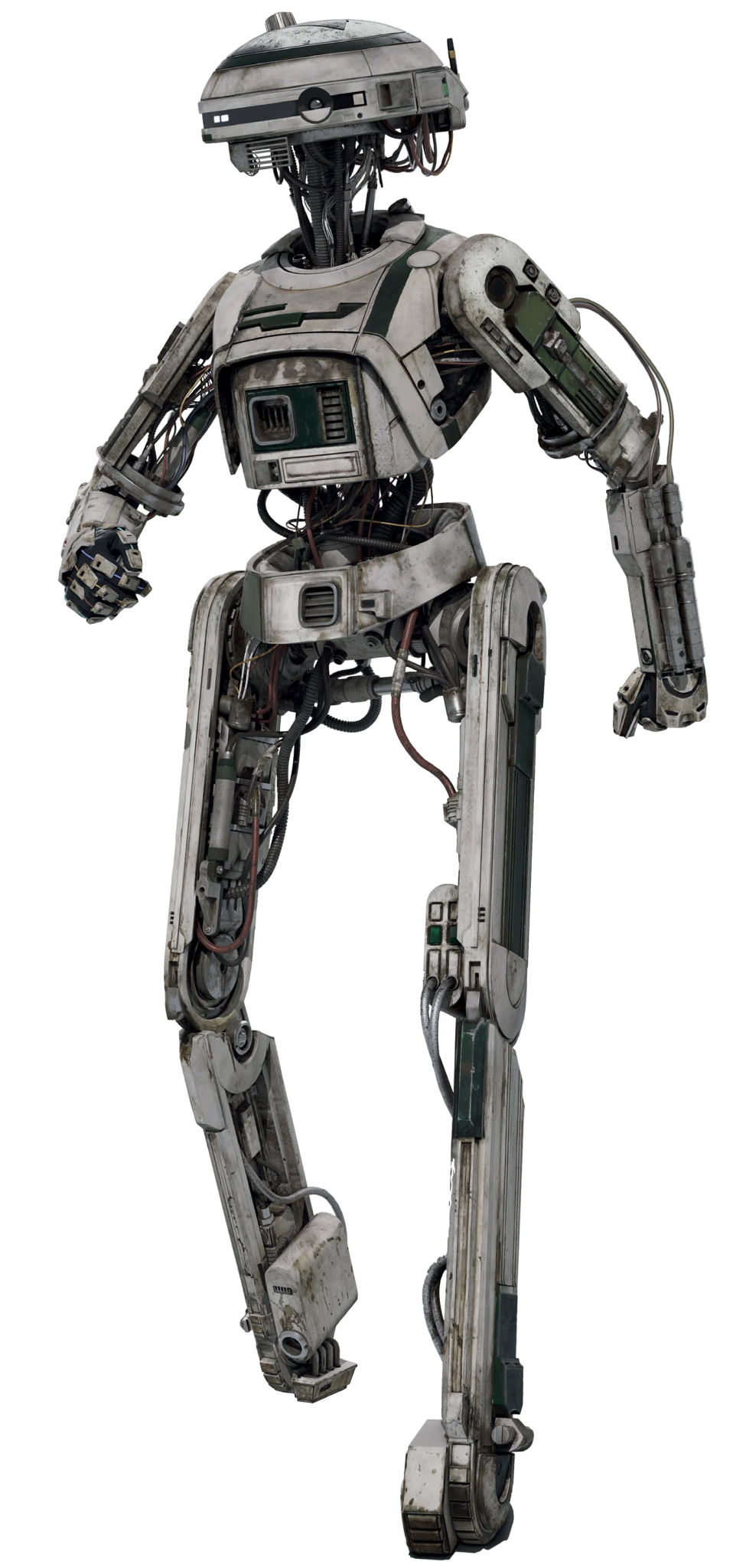
First class droids
The first class was made up of droids skilled in mathematical, physical, and medical sciences. Examples included the JN-66 analysis droid, the 2-1B surgical droid, the midwife droid, the DD-13 tripedal medical droid, and the GH-7 series medical assistance droid.
Second class droids
Droids of the second class were skilled in engineering and technical sciences. Examples included the DUM-series pit droid, the PLNK-series power droid, and the WED-15 Septoid Treadwell.
Third class droids
Third class droids were skilled in social sciences and service functions. Examples included the CZ secretary droid, the LEP-series service droid, the FA-5 valet droid, and the BD-3000 luxury droid.
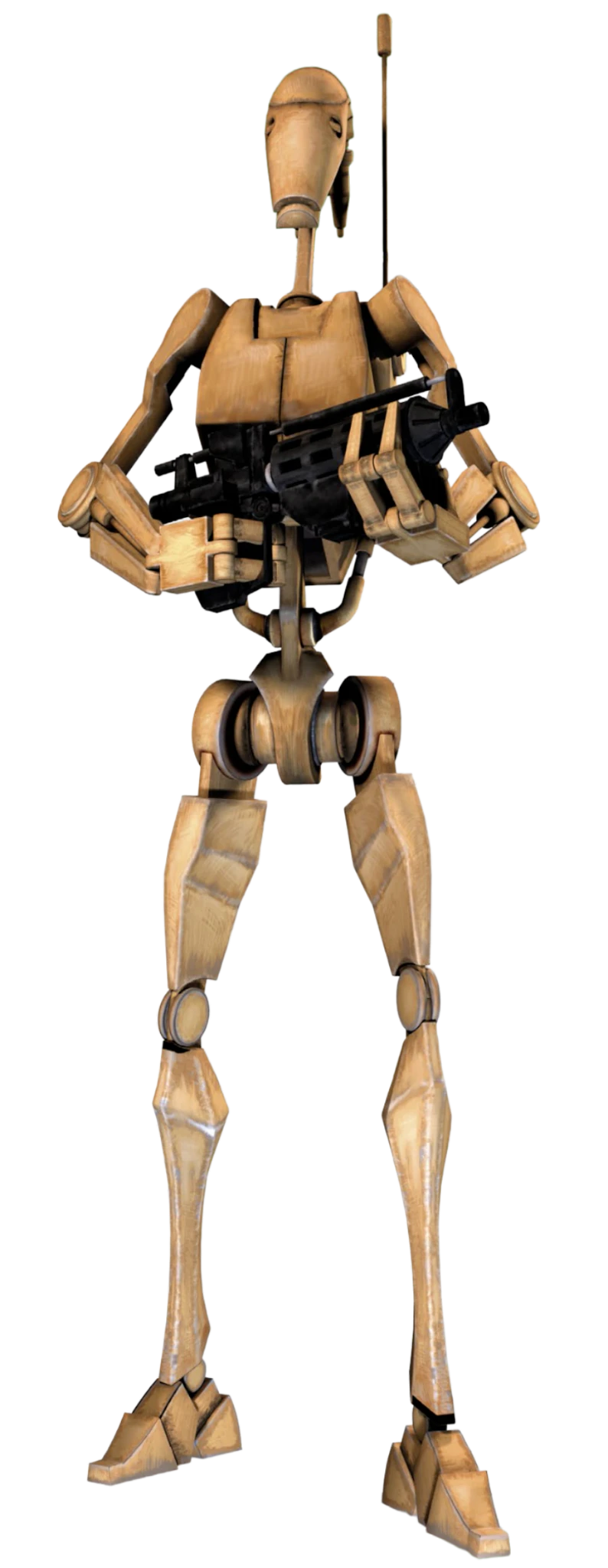
Fourth class droids
Droids of the fourth class were skilled in military and security functions. Examples included the GU-series Guardian police droid, the KX-series security droid, and the B1-series battle droid.
Fifth class droids
Fifth class droids were programmed for manual labor and intensive jobs that did not require a high level of intelligence. Examples included the GNK-series power droid, the MSE-6 series repair droid, the IW-37 pincer loader droid, the R-H029 sifter droid, the PK-series worker droid, and the UX-53 Autopolisher MK.II Droid.
Sources
Adapted from the original article, under CC BY-SA 3.0.